
Most New Zealand businesses do some training. Far fewer have a plan that links training to the real risks and skills in the business, keeps records, and checks that people can actually do the job afterwards. A good staff training plan does all three. It also helps you meet your duties under the Health and Safety at Work Act 2015 (HSWA), which are changing on 1 April 2027. This guide walks through a simple six-step approach that works for small and medium businesses.
Key takeaways
- Under HSWA, a business (PCBU) must provide the information, training, instruction or supervision needed to protect people from risks at work.
- The General Risk and Workplace Management Regulations 2016 say workers need adequate training, or supervision by someone with enough knowledge and experience, for the work they do.
- From 1 April 2027, the Health and Safety at Work Amendment Act 2026 puts more focus on critical risks. Small businesses (fewer than 20 workers) will have their main duties focused on those risks.
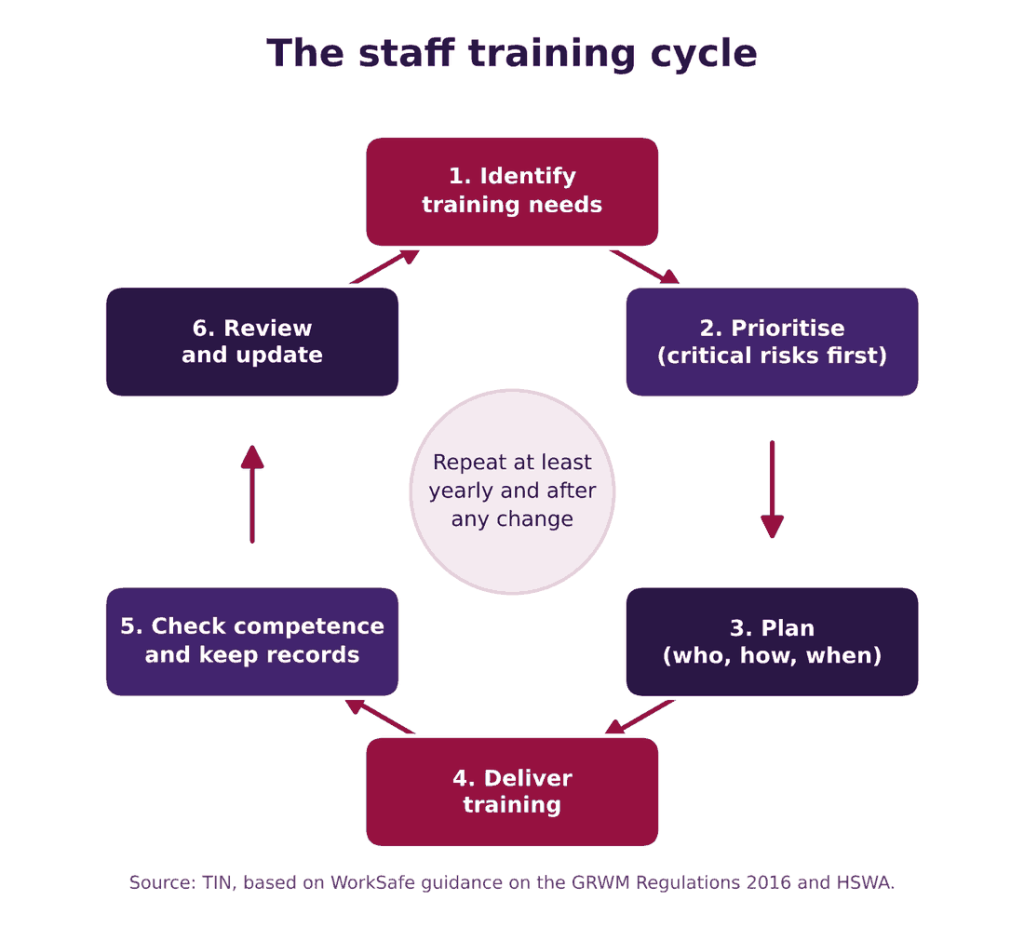
- A training plan that works follows a cycle: identify needs, prioritise, plan, deliver, check competence and keep records, then review.
- Keep training records even where the law does not spell out a format. They show what was done and help you spot gaps.
Why a training plan matters
Training is easy to treat as a box-ticking exercise: an induction on day one, a refresher when someone remembers. The trouble is that skills fade, roles change and new equipment arrives. A plan turns training into a routine part of running the business.
There is also a legal reason. HSWA’s primary duty of care requires a PCBU, so far as is reasonably practicable, to provide the information, training, instruction or supervision needed to protect workers and others from risks arising from the work. WorkSafe’s guidance on the General Risk and Workplace Management Regulations adds detail. Workers should only do tasks they have adequate knowledge or experience for, or they must be supervised by someone who does. Training should cover the plant, substances and equipment people use, and the tasks they may be asked to do, such as covering for an absent colleague. It must be readily understandable to the people receiving it.
Directors and other officers have a part to play too. Their due diligence duty includes making sure the business has, and uses, the right resources and processes to manage risk. Training is one of those resources.
What changes on 1 April 2027
The Health and Safety at Work Amendment Act 2026 passed in July 2026, and its changes take effect on 1 April 2027. WorkSafe’s summary highlights a sharper focus on critical risks. These are risks that could cause death, a notifiable injury or illness, a notifiable incident, or a listed occupational disease.
For small businesses, defined as having fewer than 20 workers for at least nine months of a financial year, the main HSWA duties will apply to critical risks. Where a hazard linked to a critical risk affects the work, a small business must still make sure, so far as reasonably practicable, that workers have adequate knowledge and experience or are adequately supervised and trained. Welfare duties such as first aid and emergency planning apply whatever the size of the business.
The practical message is simple. If your training plan already starts from your biggest risks, you are well placed for the change.
The six-step training cycle
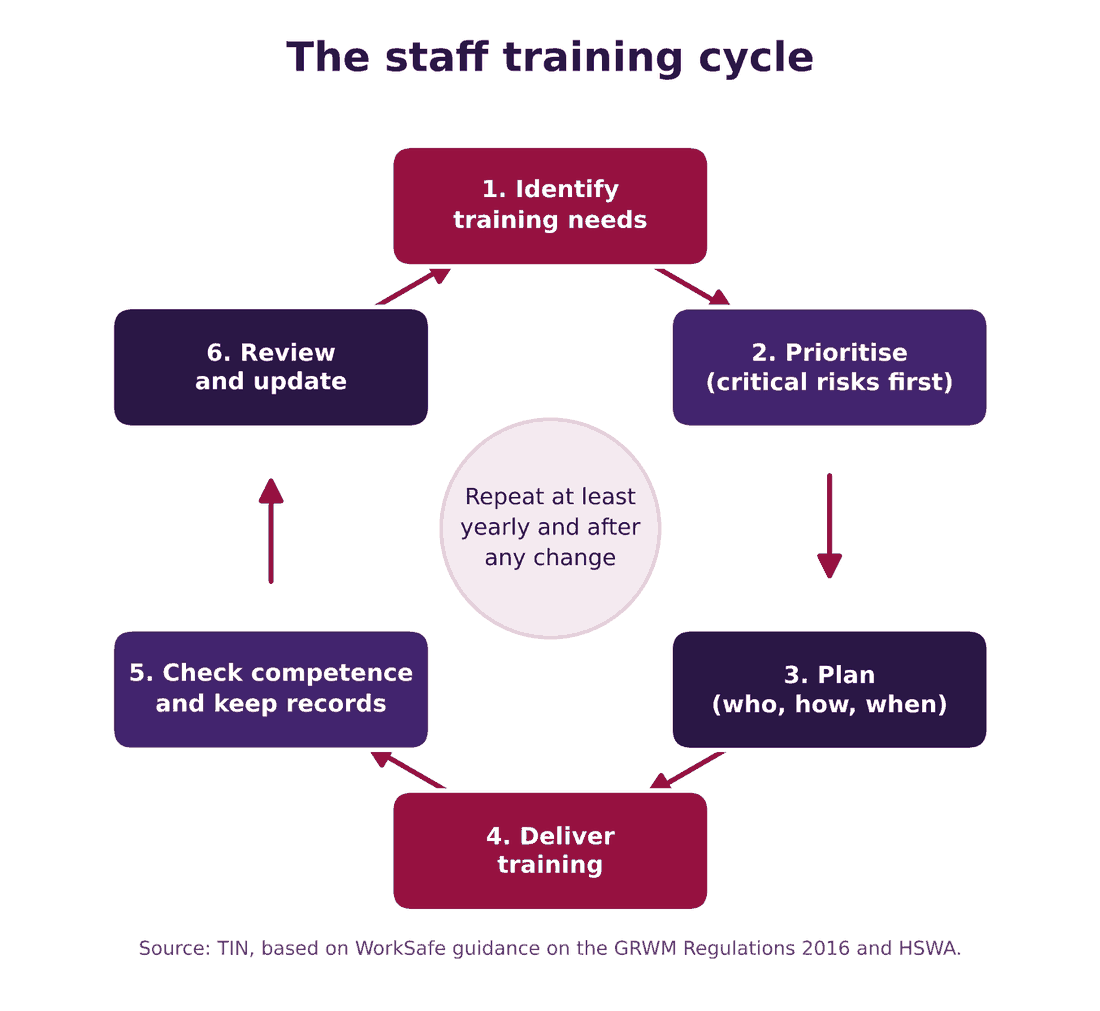
1. Identify training needs. List every role and the tasks, equipment and substances each one involves. Use your risk register, incident and near-miss reports, and conversations with workers. Ask what new starters struggle with and what experienced staff wish they had been told.
2. Prioritise. Put critical risks first: anything that could seriously harm someone, such as work at height, vehicles and mobile plant, hazardous substances, electricity or confined spaces. Then add legal and licence requirements, such as first aid, forklift certificates or health and safety representative training. Skills development comes next.
3. Plan. For each training need, record who needs it, how it will be delivered (on the job, in-house, external course or online), who will deliver it, when, and how often a refresher is due. Keep it in a simple spreadsheet or training matrix so you can see gaps at a glance.
4. Deliver. Use the method that suits the task and the people. Practical skills are best learned hands-on with supervision. Use plain language and check understanding, especially for workers who have English as a second language. Remember that WorkSafe expects you to engage with workers when deciding how training and information will be provided.
5. Check competence and keep records. Attendance is not the same as competence. Watch people do the task, ask questions, and sign them off only when they can do it safely. Record the date, trainer, content and sign-off. Some sector guidance, such as the Ministry of Education’s for schools, expects training records to be signed as evidence of completion.
6. Review and update. Review the plan at least once a year, and whenever something changes: new equipment, a new process, an incident, or a change in the law, such as the April 2027 amendments. Feed what you learn back into step one.
Common mistakes to avoid
- Training once and never again. Set refresher dates for skills that fade or carry high risk, and for first aid.
- Forgetting temporary, casual and part-time workers. They face the same risks and often get the least training. WorkSafe’s guidance on emergency plans, for example, expects plans to reach all workers, including part-time and casual staff.
- Relying on paperwork alone. A signed sheet does not prove someone can do the job. Check on the floor.
- No budget. Officers should make sure resources are available when needed. Put training in the annual budget rather than paying for it only when something goes wrong.
- Ignoring visitors and contractors. Short inductions and supervision for others at the workplace are part of managing risk.
Frequently asked questions
Does the law say how often refresher training must happen?
Not in general. HSWA and the regulations require training to be adequate for the work and the risks. Some topics, such as first aid certificates or licences, have their own renewal periods. Set refresher dates based on risk and on how quickly skills fade.
Do I have to keep training records?
The general regulations do not set out a single format for training records, but keeping them is good practice. Records help you show what you have done, spot gaps and plan refreshers.
We are a small business. What changes for us in 2027?
From 1 April 2027, small businesses’ main HSWA duties focus on critical risks. Training for work involving those risks still matters, and welfare duties apply regardless of size. Check WorkSafe’s guidance as it is updated.
Can supervision replace training?
WorkSafe’s guidance says supervision by someone with adequate knowledge or experience can be used instead of training in some situations. It should be real supervision, matched to the level of risk.
Get help building your training plan
Technical Institute New Zealand offers Training and Health & Safety services for New Zealand businesses. We can help you identify training needs, put together a practical plan and prepare for the April 2027 changes. Call 021 081 75976, email admin@tin.ac.nz or get in touch through our contact page.
Sources
- WorkSafe – General risk and workplace management (Part 1)
- WorkSafe – Introduction to the Health and Safety at Work Act 2015 (special guide)
- WorkSafe – Understanding the changes to health and safety law
- WorkSafe – Managing critical risks for small PCBUs
- Ministry of Education – Induction, training and information