
Updated 7 October 2026 · Technical Institute New Zealand
If you own a rental, manage property, or employ people who drive or work with machinery, one word sums up 2027: compliance. New Zealand’s meth rules for rental homes and drivers are already law. 2027 is the first full year that landlords, tenants, employers and the Tenancy Tribunal will all have to work under them.
Meth use roughly doubled in 2024 and has stayed high. The Government has responded with legal contamination limits for rentals, roadside drug testing and a new plan against organised crime. This guide covers what has changed, what it means for your property or business, and what to have in place before the new year.
How much meth is New Zealand using?
Police test wastewater from sites covering almost 80% of the population, and it is the most reliable measure we have. In 2025, at least 1,751 kg of meth was used at those sites, up from 1,434 kg in 2024. Weekly use jumped from about 18 kg in early 2024 to more than 32 kg by the September quarter, and it has not come back down.
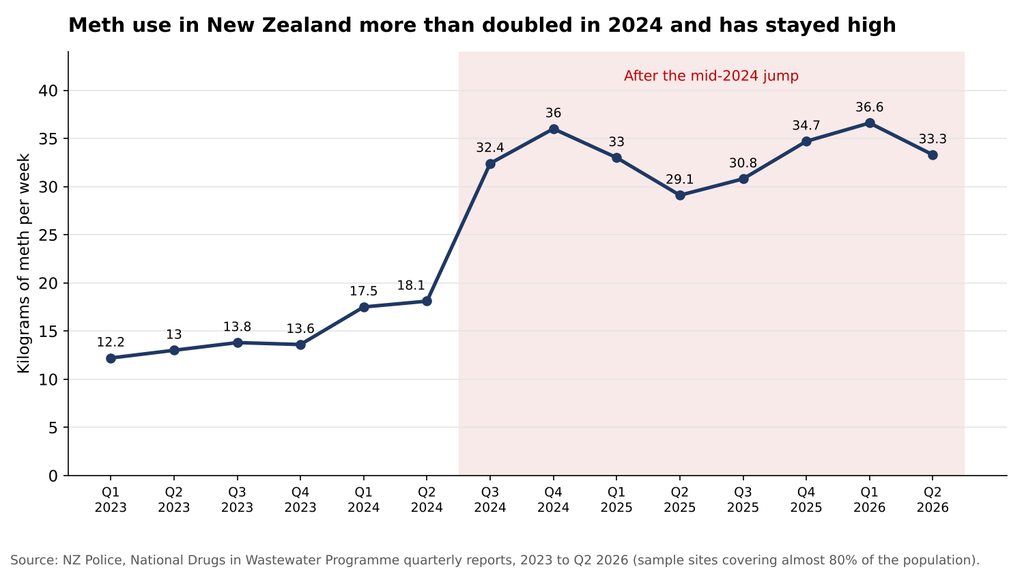
Figure 1. Estimated meth use per week at wastewater testing sites, 2023 to June 2026. Source: NZ Police, National Drugs in Wastewater Programme.
The latest figures, for April to June 2026, show 33.3 kg a week, down from 36.6 kg in the first quarter. Police say April was exceptionally high and May and June were lower, so it is too early to call it a turning point. Meth use in that quarter cost an estimated $34.9 million a week in social harm, and Police describe that figure as conservative.
The bigger change is in how people use it. New Zealand Drug Trends Survey data show that 57% of people who use meth now use it weekly or more, up from 27% in 2018/19 (SafetyNews NZ). The number of people using meth has not grown much, but those who use it are using more. Heavier use leaves more residue in homes and causes more impairment at work and on the road.
What has changed: before and now
For property owners, the main change is that rental contamination now has legal limits. These have been in force since 16 April 2026.
| Area | Before | Now (October 2026) |
|---|---|---|
| Rental contamination limits | No regulations. The benchmark moved from 0.5 (2010 guideline) to 1.5 (NZS 8510:2017) to 15 micrograms per 100 cm² (2018 science advice) | Above 15 must be decontaminated. Above 30 is legally uninhabitable (MHUD) |
| Testing a rental | Voluntary, often done at every change of tenancy | Still optional between tenancies. A professional test is required if Police or a council say meth was likely made there, or if a screening test is above 15 |
| Telling tenants | No set rule | Tenants must get test results within 7 days (Tenancy Services) |
| Drug driving | Compulsory impairment test only | Roadside saliva screening for THC, meth, MDMA and cocaine. Started December 2025, nationwide from 1 July 2026. A confirmed single drug means a $200 fine and 50 demerit points |
| Organised crime and the border | Existing Police and Customs powers | Ministerial group set up in March 2025, an extra $23.1 million in October 2025, and work on insider threats at ports and airports (Ministry of Justice) |
| Health response | Treatment courts and police referrals to health services | Addiction access targets and the Action Plan to Prevent and Reduce Substance Harm 2026 to 2029 |
| Cold medicine with pseudoephedrine | Prescription only from 2011 | Back on pharmacy shelves since 2024 |
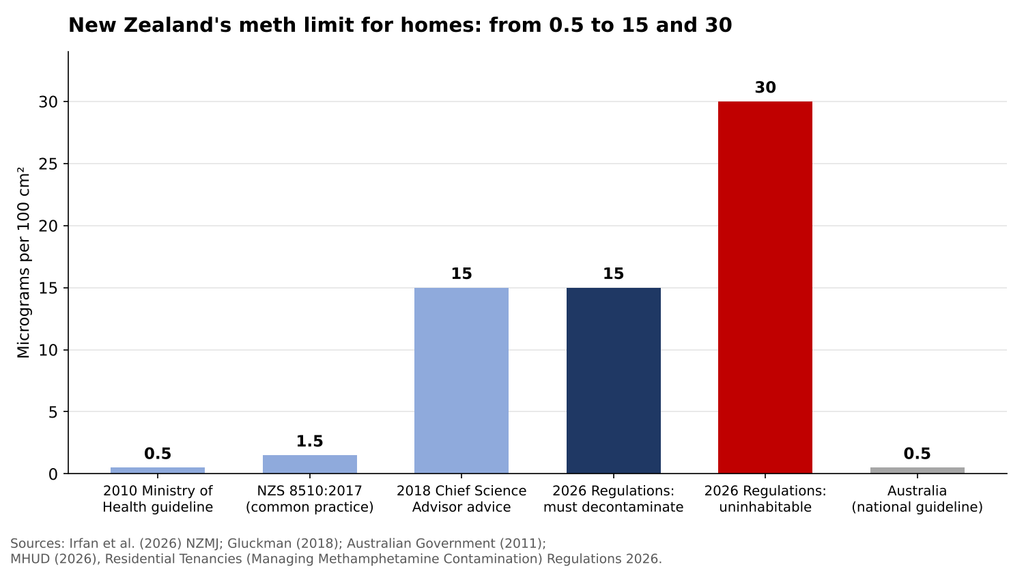
Figure 2. Meth residue levels used for New Zealand homes over time, in micrograms per 100 cm², compared with Australia. Sources: Irfan et al. (2026); Gluckman (2018); MHUD (2026); Australian Government (2011).
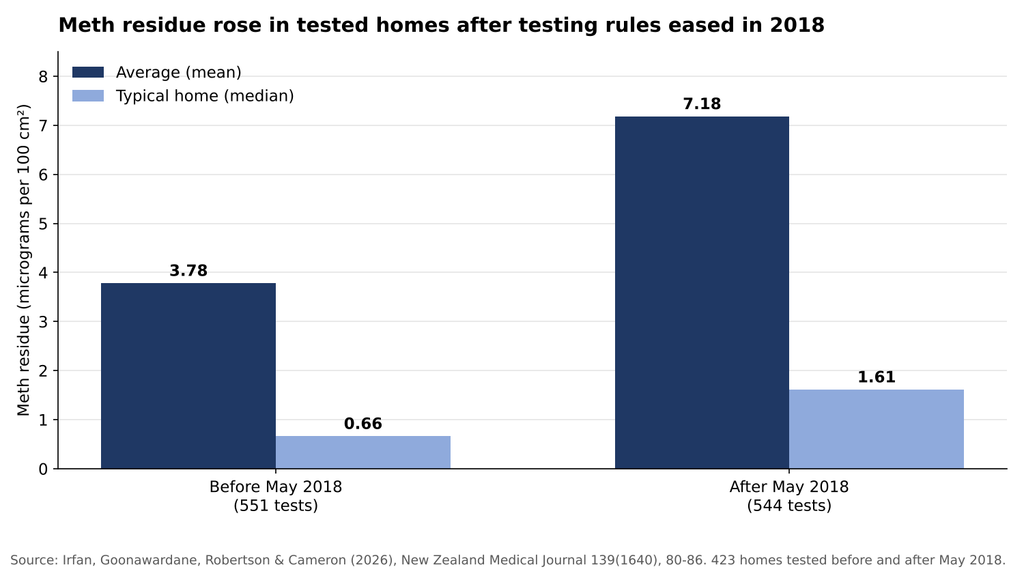
Before you decide whether to test, look at what happened last time testing became less common. After the 2018 advice, far fewer homes were tested. A New Zealand Medical Journal study followed 423 homes that were tested both before and after that change. Average residue went from 3.78 to 7.18 micrograms per 100 cm². Once the researchers allowed for differences between properties, the rise linked to the policy change was 1.93, about half again on the earlier average (Irfan et al., 2026). The study only covers homes whose owners chose to test, so it does not tell us about every rental. It does suggest that testing less means problems are found later.
Rental property checklist for 2027
Landlords and property managers should have these in place before the new year.
- Learn the two numbers. At 15 micrograms per 100 cm² the property must be decontaminated. At 30 it is uninhabitable, and either the landlord or the tenant can end the tenancy.
- Decide on your testing policy. Testing between tenancies is optional, but a baseline test at move-in and move-out is your best evidence if a dispute goes to the Tenancy Tribunal.
- Know when a test is compulsory: when Police or the council say meth was likely made at the property, or when a screening test comes back above 15.
- Use testers who follow the method set out in the Regulations. Ask which laboratory they use and keep the full report, not just the summary page.
- Give tenants their results within 7 days.
- If a result is above 15, decontaminate using the process based on NZS 8510 before you re-let, and keep the clearance report.
- Plan for a result above 30. Budget for lost rent and clean-up costs, and know how you will end or pause the tenancy.
- Update tenancy agreements, inspection checklists and photo records, so any change in the property’s condition is on file.
- Ask your insurer how its meth cover fits the new 15 and 30 limits.
- If you sell, remember that the Real Estate Authority uses 15 as the level at which a test result must be disclosed to buyers.
For the exact legal wording, check Tenancy Services or get legal advice for your situation.
What employers need to do
Amphetamine-type drugs, which include meth, made up about a quarter of positive workplace drug tests in late 2025 (Line of Defence). Employers have a duty under the Health and Safety at Work Act to manage that risk.
Transport, logistics and fleet operators now work alongside nationwide roadside testing. A positive roadside screen can take a driver off the road for 12 hours, so drug and alcohol policies should match the roadside rules, and rosters should allow for a stood-down driver.
Farming, forestry and construction businesses run vehicles and heavy machinery every day. Review your pre-employment, post-incident and reasonable-cause testing, and train supervisors to recognise impairment.
Ports, airports and freight companies are under closer watch for insider risk. In March 2025, Customs arrested three airport workers over about 58 kg of meth taken off an international flight (NZ Customs). Check your vetting and access controls, and give staff a safe way to raise concerns.
Health, aged care and community services will see more people with complex needs as heavy use grows. Staff need to know how to recognise stimulant harm and where to refer people.
Testing on its own does not make a workplace safe. Pair any testing programme with an employee assistance service and a clear path back to work after treatment.
What will happen in 2027
Meth use is likely to stay high, and 2027 will show how the new rules work in practice. Based on Police wastewater data since mid-2024, we expect testing sites to record roughly 1,500 to 2,000 kg of meth next year, most likely around 1,700 kg. That is a planning range, not a forecast.
- The Tenancy Tribunal will issue its first decisions under the 2026 Regulations, showing how the 15 and 30 limits and the 7-day rule are applied.
- A full year of nationwide roadside testing will produce the first annual results, and a fresh debate about whether the tests measure recent use or actual impairment.
- New Zealand votes on 7 November 2026. The incoming Government will decide which meth-related bills from the last Parliament go ahead, including changes on organised crime and asset recovery.
- The health action plan enters its second year, with a target of getting 80% of people into specialist addiction care within three weeks.
- Supply pressure will continue. Meth seizures in East and South-East Asia reached a record 349 tonnes in 2025, up 48% in one year (UNODC).
We will update this article as the 2027 decisions and data come in.
Frequently asked questions
What is the legal meth limit for a rental property in New Zealand?
Since 16 April 2026, a rental with meth residue above 15 micrograms per 100 cm² must be decontaminated. Above 30 it is legally uninhabitable.
Do landlords have to test for meth between tenancies?
No, testing between tenancies is optional. It becomes compulsory if Police or a council say meth was likely made at the property, or if a screening test is above 15 micrograms per 100 cm².
What happens if a rental tests above 30 micrograms per 100 cm²?
The property is treated as uninhabitable, and the landlord or the tenant can end the tenancy. It must be decontaminated before anyone lives there again.
How quickly must tenants see meth test results?
Tenants must receive the results within 7 days.
What is the penalty for drug driving under the new roadside tests?
A second positive roadside screen means a 12-hour driving ban. If the laboratory confirms one drug, the penalty is a $200 fine and 50 demerit points.
Is meth use still rising in New Zealand?
Use doubled in 2024 and stayed high through 2025. It eased slightly between April and June 2026, but people who use meth are using it more often than before.
Talk to Technical Institute New Zealand
The rules have changed quickly, and 2027 will bring Tribunal decisions, new data and possibly a new Government agenda. Technical Institute New Zealand (TIN) offers education, training and consulting to help people and organisations keep up. We can run plain-English briefings on the new rental rules for landlords and property teams, deliver workplace health and safety training on drugs and impairment, and help you write policies that fit the 2026 Regulations.
Contact us: call 021 081 75976, email admin@tin.ac.nz, or use our contact form.
Sources
- New Zealand Police. National Drugs in Wastewater Testing Programme: 2025 annual overview and Quarter 2, 2026.
- Ministry of Housing and Urban Development. Regulation of methamphetamine contamination in rental housing.
- Tenancy Services. New methamphetamine contamination rules now in effect.
- Ministry of Justice. Actions to combat methamphetamine.
- Ministry of Health. Action Plan to Prevent and Reduce Substance Harm 2026-2029.
- Irfan, M., Goonawardane, U. I., Robertson, C., & Cameron, M. P. (2026). The impact of New Zealand’s 2018 methamphetamine policy on residential contamination. New Zealand Medical Journal, 139(1640), 80-86.
- Gluckman, P. (2018). Methamphetamine contamination in residential properties. Office of the Prime Minister’s Chief Science Advisor.
- Australian Government. (2011). Clandestine drug laboratory remediation guidelines.
- New Zealand Customs Service. Customs arrests three airport workers for smuggling 58 kilograms of methamphetamine.
- UNODC. Synthetic drugs in East and South-East Asia 2026.
- SafetyNews NZ. Meth use is “massive” across the nation and in the workplace.
- Line of Defence. Workplace drug testing results, Q4 2025.
This article is general information, current at 7 October 2026. It is not legal advice. Check Tenancy Services or a lawyer before making decisions about a specific property or workplace.