
Australia vs New Zealand for International Students in 2026: Two Neighbours, Two Very Different Directions
Australia and New Zealand sit side by side on the map, but in international education they are now moving in opposite directions. Since mid-2024 Australia has more than tripled its student visa fee, capped new enrolments and refused visas at record rates. Over the same period New Zealand has widened work rights, set a target of 119,000 international students by 2034 and watched enrolments climb past 92,000.
For students choosing where to study, and for New Zealand providers like Technical Institute of New Zealand (TIN), this shift brings real opportunity. It also brings a test: can our quality and student support grow as fast as our numbers?
Key takeaways
- Australia’s student visa fee rose from A$710 to A$2,500 between July 2024 and July 2026.
- Australia’s 2026 cap (the National Planning Level) is 295,000 new international students.
- About one in three offshore higher education visa applications to Australia was refused in June 2026.
- New Zealand had 92,580 international students in 2025, more than double the 41,360 in 2022.
- Students in New Zealand can now work 25 hours a week during study, up from 20.
- New Zealand’s Going for Growth plan targets 105,000 students by 2027 and 119,000 by 2034.
- Quality is what protects growth. Past booms in New Zealand’s PTE sector ended in crackdowns that hurt good providers too.
Australia: higher fees, enrolment caps and record visa refusals
Australia is still a major study destination, but it has become much harder and more expensive to get in. Three changes stand out.
1. The world’s most expensive student visa
The standard Student visa (subclass 500) fee is now about 3.5 times what it was two years ago. Australia now charges more for a student visa than the UK, the USA or Canada.
| Date | Student visa fee (primary applicant) | Change |
| Before 1 July 2024 | A$710 | – |
| 1 July 2024 | A$1,600 | +125% |
| 1 July 2025 | A$2,000 | +25% |
| 1 July 2026 | A$2,500 | +25% |
The fee is non-refundable, so a refused applicant loses it and must pay again to reapply. The Temporary Graduate (subclass 485) visa also rose, from A$4,600 to A$5,750. Students must also show around A$29,710 a year in living funds.
2. A cap on new international students
Australia now manages new international enrolments through a National Planning Level. It was set at 270,000 for 2025 and 295,000 for 2026. Each university and college gets an allocation, and a Ministerial Direction tells visa officers how to prioritise applications.
3. Record visa refusal rates
The sharpest change has been in visa outcomes. In June 2026, 32% of higher education visa applications lodged offshore were refused, roughly one in three. For some South Asian countries it was far worse: only 46% of applications from India, 22% from Bangladesh and 14% from Nepal were granted that month.
The overall student visa refusal rate across all sectors reached 24.2% in June 2026, the highest in a decade. Applicants also face the Genuine Student test, which asks whether they are coming mainly to study rather than to work.
For students and families, the message is clear: Australia is no longer an easy option, and a failed application is expensive.
New Zealand: rising enrolments, wider work rights and a 2034 growth target
New Zealand has gone the other way. When our borders reopened in 2022 we had just 41,360 international students, down from 115,705 before Covid. By 2025 that had climbed to 92,580, an 11% rise on 2024 alone.
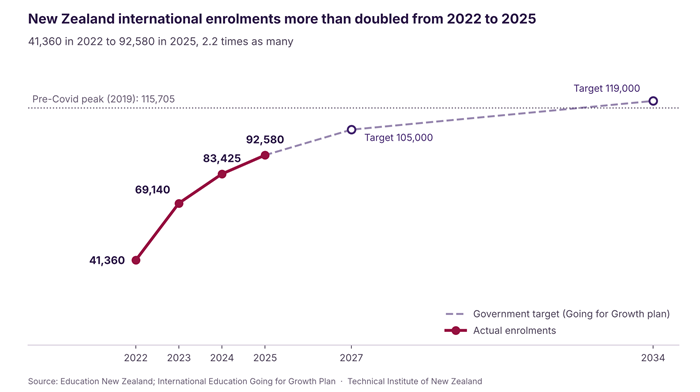
Line chart: New Zealand international enrolments rose from 41,360 in 2022 to 92,580 in 2025, with government targets of 105,000 by 2027 and 119,000 by 2034
More time to work while studying
From 3 November 2025, eligible tertiary students can work up to 25 hours a week during study, up from 20. Many can still work full-time in scheduled breaks. For students weighing living costs, those extra five hours matter.
A government plan to grow
In July 2025 the government released the International Education Going for Growth Plan. It aims to grow enrolments to 105,000 by 2027 and 119,000 by 2034, and to double the sector’s value to NZ$7.2 billion. Early 2026 data shows enrolments up another 8% on the same period in 2025, putting New Zealand on track for about 99,000 students this year.
New Zealand is also becoming a first choice. In Education New Zealand’s latest survey, 22% of prospective students ranked New Zealand in their top three destinations. That is the plan’s 2034 target, reached eight years early.
Is Australia’s crackdown driving New Zealand’s growth?
Not entirely, but the timing is hard to miss. New Zealand’s recovery began before Australia’s toughest changes, and our providers have worked hard to rebuild after Covid. Still, when one door gets harder to open, students and agents look for the next one. The UK, Canada and the USA have also tightened their settings, so New Zealand stands out more than it used to.
The detail of where students are going tells us something too:
- Universities are leading. Our eight universities had about 38,000 international enrolments in 2025, a record and 41% of all international students.
- New markets are growing fast. Nepali student numbers nearly doubled, from 1,555 in 2024 to 2,660 in 2025, mostly in PTEs.
- The same countries Australia is refusing are looking at us. India, Nepal and Bangladesh face some of Australia’s highest refusal rates, and they are important markets for New Zealand’s vocational sector.
- China and India remain the biggest sources, at 34% and 14% of New Zealand’s 2025 enrolments.
That last point is where opportunity and risk meet. Fast growth from a few markets, much of it into vocational programmes, is exactly the pattern New Zealand has seen before.
Lessons from past booms and crashes in New Zealand’s PTE sector
I have worked in the private training establishment (PTE) sector long enough to see a few booms and a few crashes. The pattern repeats.
In the mid-2010s, PTE international enrolments peaked at about 43,000. Some providers chased volume over quality. NZQA and Immigration New Zealand responded with inspections, deregistrations and tighter rules. Several PTEs closed, leaving hundreds of international students looking for somewhere to finish their studies. PTE numbers have never returned to that peak.
Three lessons stand out:
- Growth can disappear quickly when policy changes. A rule change in Wellington, or in a source country, can halve a pipeline within a year. Australia’s 2026 visa data shows how fast that can happen.
- Good providers get hurt along with the weak ones. When a few providers cut corners, the whole sector’s reputation suffers and the response tends to land on everyone.
- What lasts is quality. Students who finish well, graduates who get decent jobs and a public that trusts the system are what keep a market open through policy cycles.
Growth arrives in the middle of vocational education reform
This growth is landing at a time of big change for New Zealand’s vocational system. From 1 January 2026:
- Ten standalone polytechnics began operating as Te Pūkenga was broken up, with more due to be established in 2027.
- Eight Industry Skills Boards (ISBs) replaced the six Workforce Development Councils. They set standards for vocational qualifications and temporarily manage work-based learning.
- NZQA is moving PTEs and polytechnics to a new quality framework, the integrated Quality Assurance Framework (iQAF). Immigration New Zealand is using existing EER ratings for 12 months while the change beds in.
Providers, staff, industry and regulators are all adjusting at the same time as international numbers climb. New systems take time to settle, and that is exactly when gaps in quality checks can appear.
What sustainable growth looks like for New Zealand providers
If quality is what protects growth, it helps to be specific about what quality means day to day. These are the questions we ask ourselves at TIN, and that any provider taking more international students could ask:
- Honest recruitment. Do agents give students accurate information about the course, costs, work rights and job prospects?
- Right student, right course. Do entry checks confirm English level, prior learning and genuine study goals before an offer is made?
- Support that scales. When enrolments rise 20%, do pastoral care, accommodation help and wellbeing support rise with them, as the Code of Practice requires?
- Completion, not just enrolment. Do we track who finishes, who struggles and why, and act early?
- Real job pathways. Are placements, employer links and industry standards built into the programme, so graduates are ready for New Zealand workplaces?
- Teaching capacity. Do we have enough qualified tutors and assessors before we add another intake?
None of this is new. But in a growth period it is easy to let it slip, and the cost of slipping is shared by everyone.
Frequently asked questions
How much is an Australian student visa in 2026?
The standard Student visa (subclass 500) fee is A$2,500 from 1 July 2026, up from A$2,000. Some applicants, such as ELICOS students and eligible ASEAN or Pacific nationals, pay a lower rate.
Is it harder to get an Australian student visa now?
Yes. In June 2026 about one in three offshore higher education applications was refused, and refusal rates for students from Nepal, Bangladesh and India were much higher.
How many hours can international students work in New Zealand?
Eligible tertiary students can work up to 25 hours a week during study, and many can work full-time in scheduled holidays. Check your own visa conditions with Immigration New Zealand.
How many international students are in New Zealand?
There were 92,580 international students in 2025. The government is targeting 105,000 by 2027 and 119,000 by 2034.
Is New Zealand a good alternative to Australia for vocational study?
For many students it can be, with lower visa costs, good work rights and NZQA-approved qualifications. Choose a provider with a strong NZQA quality rating and clear links to employers in your field.
Are we ready? Join the conversation
New Zealand has a real chance to grow international education well. The question is whether we grow it in a way that lasts.
- Are we ready for this growth?
- Can our quality checks and student support keep up?
- What are you seeing in your own institution: new markets, pressure on staff, changes in student needs?
I’d like to hear from education colleagues across New Zealand. Share your view with us at admin@tin.ac.nz or call 021 081 75976. If you are a student thinking about studying in New Zealand, contact Technical Institute of New Zealand to talk about our courses and support.
Sources
- Australian visa fee increases from 1 July 2026 (IDP)
- Student visa fee history: A$710 to A$2,500 (SBS)
- A managed system for international education, National Planning Level 2026 (Australian Department of Education)
- June 2026 offshore higher education visa refusals (Times Higher Education)
- Student visa refusal rate 24.2% in June 2026 (RACC Australia)
- 92,580 international students in 2025 (Education New Zealand)
- 41,360 international students in 2022 (Education New Zealand)
- 2026 enrolments and export earnings (The PIE News)
- Going for Growth Plan targets (1News)
- Student work rights rise to 25 hours (IDP)
- Nepali enrolments and 2025 growth (ICEF Monitor)
- Record university enrolments and PTE peak (Times Higher Education)
- Standalone polytechnics and Industry Skills Boards (TEC)
- New quality assurance framework and student visas (Immigration New Zealand)