
Asbestos awareness for property owners and managers in New Zealand
Asbestos is still in many New Zealand buildings. Left alone and in good condition, it may pose little risk. Disturbed during repairs, renovations or demolition, it can release fibres that cause serious disease years later. If you own, manage or let property, this guide explains where asbestos is found, what the law expects and the practical steps to manage it.
Key takeaways
- WorkSafe says about 220 people die from asbestos-related disease in New Zealand each year. It is the leading cause of work-related death.
- Buildings built before 1 January 2000 are likely to contain asbestos. Assume it is there until a competent person confirms it is not.
- Workplaces with asbestos need an asbestos register and a written asbestos management plan, reviewed at least every five years.
- Residential landlords have duties too when work at their property could expose workers or tenants to asbestos.
- Removal of more than 10 m² of non-friable asbestos, or any friable asbestos, needs a licensed removalist.
Why asbestos still matters
Asbestos was widely used in building products because it is strong, cheap and resists heat. Importing products that contain asbestos has been banned since 1 October 2016, unless the Environmental Protection Authority grants a permit. But many older buildings still contain it.
The danger comes when asbestos is damaged or disturbed, for example by drilling, sanding, cutting or water-blasting. Breathing in the fibres can cause asbestosis, lung cancer and mesothelioma. These diseases often appear decades after exposure and usually cannot be cured. In April 2026, WorkSafe’s chief executive said asbestos remains the number one cause of work-related death in New Zealand, with about 220 people dying from asbestos-related disease each year.
Where you might find asbestos
You cannot tell whether a material contains asbestos by looking at it. The only way to know is to have a sample tested. WorkSafe lists many places it can turn up, including:
- Roofs and exteriors: corrugated roof sheeting, soffits, cladding, gutters, downpipes, fences and garages
- Interiors: textured or “popcorn” ceilings, wall and ceiling sheeting, vinyl flooring and the adhesive underneath, and partition walls
- Wet areas: bathroom and laundry linings, splashback backing, and toilet cisterns
- Services: insulation around heaters, fireplaces and hot water pipes, flues, and electrical meter boards
If your building or house was built before 1 January 2000, treat these materials with care until you know what they are.
What the law expects
Under the Health and Safety at Work Act 2015 and the Health and Safety at Work (Asbestos) Regulations 2016, a person conducting a business or undertaking (PCBU) that manages or controls a workplace must manage asbestos risks. In plain terms, that means:
- Identify asbestos: take reasonably practicable steps to find asbestos at the workplace. A competent person should inspect and take samples. Areas that cannot be reached must be assumed to contain asbestos.
- Keep an asbestos register: record the location, type, condition and estimated quantity, plus any inaccessible areas and sample results.
- Write an asbestos management plan: set out where the asbestos is, the decisions made about controlling the risk and why, what to do if there is an incident, and the information and training workers need. Keep it at the workplace and make it easy for workers and contractors to see.
- Review the plan: at least every five years, and sooner if asbestos is removed, disturbed, sealed or enclosed, or if a worker representative asks.
- Before demolition or refurbishment: have a competent person identify asbestos and remove it, so far as is reasonably practicable, before work starts.
WorkSafe says residential landlords must also make sure work at their property is done safely. Where work could expose workers or tenants to asbestos fibres, landlords need to identify the asbestos and prepare an asbestos management plan covering the work area and access routes.
Health and safety law is changing. The Health and Safety at Work Amendment Act 2026 comes into force on 1 April 2027. WorkSafe released updated asbestos guidance in April 2026 and expects some of it to become updated codes of practice after the reforms. The 2016 approved code of practice remains in place for now.
Practical steps for owners and managers
The steps below follow WorkSafe’s guidance and suit most commercial buildings, rental properties and shared workplaces.
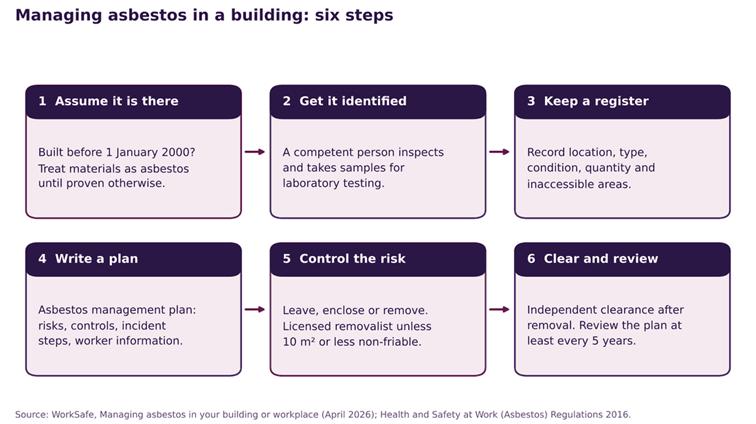
Figure 1: Six steps for managing asbestos in a building. Source: WorkSafe, Managing asbestos in your building or workplace (April 2026); Health and Safety at Work (Asbestos) Regulations 2016.
A few practical tips:
- Talk to tradespeople before work starts. Share your asbestos register and plan with anyone drilling, cutting or renovating.
- Do not leave sealing as a permanent fix. Enclosing, encapsulating or sealing asbestos does not remove the hazard. It needs ongoing checks.
- Use the right removalist. Up to 10 m² of non-friable asbestos can be removed without a licence, following safe practice. More than that needs a Class B licence. Friable asbestos, which crumbles easily, always needs a Class A licensed removalist and independent air monitoring.
- Get clearance before re-entry. After licensed removal, an independent asbestos assessor checks the area and confirms in writing that it is safe.
- Dispose of waste properly. Asbestos waste must go to an authorised disposal site. Never burn it or put it in household bins.
- Communicate. Let workers, tenants and neighbours know before removal work starts.
Training and awareness
Plans only work if people follow them. Property managers, maintenance staff and contractors should know how to recognise materials that might contain asbestos, what the register says and what to do if something is damaged. Short awareness training, clear signage and a simple “stop and check” rule before any drilling or cutting go a long way.
Frequently asked questions
Does my building need an asbestos management plan?
If you manage or control a workplace and asbestos has been identified or is likely to be present, you need an asbestos management plan. Buildings built before 1 January 2000 are the main concern.
Can I remove asbestos myself?
WorkSafe strongly recommends using a reputable asbestos contractor. In a workplace, up to 10 m² of non-friable asbestos may be removed without a licence using safe work practices. Anything more, and any friable asbestos, needs a licensed removalist.
How often should the plan be reviewed?
At least every five years, and sooner if asbestos is removed, disturbed, sealed or enclosed, if the plan no longer fits the risks, or if a worker representative asks for a review.
I am a landlord. Do these rules apply to me?
WorkSafe says residential landlords must make sure work at their property is done safely. If work could expose workers or tenants to asbestos, you need to identify the asbestos and prepare a management plan for that work.
Get practical support
TIN’s Health & Safety and Property & Environmental Consulting services can help you understand your duties, put a plan in place and train your team in asbestos awareness. Call 021 081 75976, email admin@tin.ac.nz or send us a message through our contact page.
Sources
- WorkSafe – Managing asbestos in your building or workplace: for PCBUs (April 2026)
- WorkSafe – Updated asbestos guidance now available (17 April 2026)
- WorkSafe – Asbestos in the home
- WorkSafe – Where asbestos can be found
- WorkSafe – Understanding the changes to health and safety law
- Imports and Exports (Asbestos-containing Products) Prohibition Order 2016 – legislation.govt.nz