If you are an apprentice, a trainee or someone thinking about a trade or care qualification, you may have heard that New Zealand’s vocational education system has changed again. Te Pūkenga is being wound down, regional polytechnics are back, and new Industry Skills Boards now look after qualifications and standards. This guide explains what has changed, what is still to come, and what it means for you as a learner.
Key takeaways
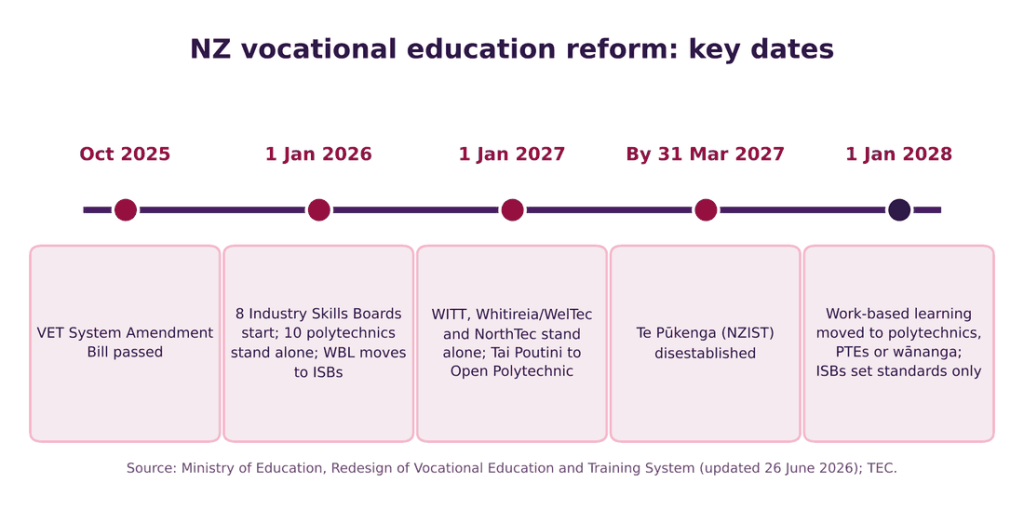
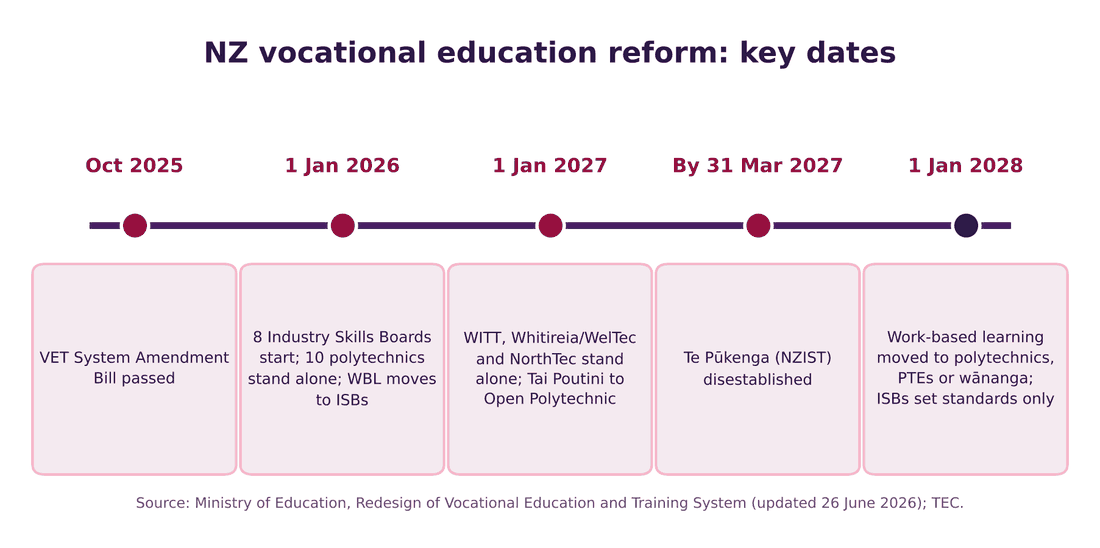
- The Education and Training (Vocational Education and Training System) Amendment Bill passed in October 2025, and the main changes took effect on 1 January 2026.
- Eight Industry Skills Boards (ISBs) started on 1 January 2026. They set standards and qualifications and advise the Tertiary Education Commission (TEC) on what training is needed.
- Ten polytechnics began operating on their own from 1 January 2026, with three more due to start on 1 January 2027.
- Te Pūkenga (now called NZIST) is a transitional body and is due to be disestablished on or before 31 March 2027.
- If you are already enrolled, your programme should carry on with as few changes as possible. Check with your provider if you are unsure.
Why the system changed again
From 2020, New Zealand’s 16 polytechnics and its industry training organisations were brought together under one national body, Te Pūkenga. The current Government decided to reverse that model and return to a more regional, industry-led system. Its stated aims are to give regions more say over their own polytechnics and to give industry a stronger voice in training.
The law change to do this went through Parliament in October 2025. The Ministry of Education reports that the select committee received 210 written submissions and heard from 32 submitters before the bill was passed with some changes. The new arrangements began on 1 January 2026.
Industry Skills Boards: who sets the standards now
Eight Industry Skills Boards began work on 1 January 2026. Each ISB covers a group of industries:
- Construction and Specialist Trades
- Education, Community and Health
- Electrotechnology and Information Technology (including creative sectors)
- Energy and Infrastructure
- Food and Fibre
- Manufacturing and Engineering
- Services
- Transport
ISBs develop qualifications and standards, support quality assurance and moderation, carry out workforce planning, and advise the TEC on where funding should go. Their boards include industry nominees and ministerial appointees, with both employer and employee voices.
For learners in health and care, the Education, Community and Health ISB is the one to watch. It is responsible for the standards behind many care and support qualifications, and it has temporarily taken over the work-based learning division known as Careerforce.
Work-based learning: a two-step move for apprentices and trainees
Work-based learning means training while you work, such as an apprenticeship or a traineeship. This is the area where learners will notice the most change over the next two years, so it helps to understand the two steps.
Step one (from 1 January 2026). The work-based learning divisions that sat inside Te Pūkenga moved to the matching ISBs. For example, BCITO moved to Construction and Specialist Trades, Careerforce to Education, Community and Health, Competenz to Manufacturing and Engineering, and MITO to Transport. Some divisions, such as BCITO, have since become industry-owned training providers. ISBs can manage this training for up to two years.
Step two (by 1 January 2028). ISBs stop managing training at the end of 2027. All remaining programmes and enrolments must move to a polytechnic, a private training establishment (PTE) or a wānanga by 1 January 2028. After that date, ISBs focus only on setting standards.
Until then, an ISB can only take new enrolments where no other provider offers a similar work-based programme. The TEC’s advice to current learners is that you should not notice immediate changes and that your programme stays the same.
Polytechnics are regional again
Ten polytechnics started operating independently on 1 January 2026:
- Ara Institute of Canterbury
- Eastern Institute of Technology (EIT)
- Manukau Institute of Technology and Unitec (as one merged entity)
- Nelson Marlborough Institute of Technology (NMIT)
- Otago Polytechnic
- Southern Institute of Technology (SIT)
- Toi Ohomai Institute of Technology
- Universal College of Learning (UCOL)
- Waikato Institute of Technology (Wintec)
- The Open Polytechnic of New Zealand
The Open Polytechnic also anchors a federation that other polytechnics can join. The Ministry of Education says three more polytechnics, WITT in Taranaki, Whitireia/WelTec and NorthTec, are set up to operate on their own from 1 January 2027. Tai Poutini Polytechnic on the West Coast is due to be managed by the Open Polytechnic from the same date. Polytechnics still under NZIST keep operating as normal until they move.
What it means for you as a learner
For most learners, the day-to-day experience should feel familiar. Here is what to keep in mind:
- Already enrolled at a polytechnic? Your polytechnic may have a new name or structure, but your programme continues. Watch for emails about any changes to student services or fees.
- Apprentice or trainee? You stay with your work-based learning division for now. Before the end of 2027 your programme is expected to move to a polytechnic, PTE or wānanga. Ask your training adviser when and how that will happen.
- Studying with a PTE or wānanga? The Ministry of Education says learners with other providers see no change.
- Choosing a course for 2027? Check the provider is NZQA-registered or otherwise recognised, ask who will deliver the programme after 2027, and confirm any fees in writing.
If you are studying an Australian qualification, such as TIN’s CHC43015 Certificate IV in Ageing Support delivered with the Australian Institute of Business and Technology (AIBT, RTO 41138), the content is set in Australia’s training system. The NZ reform does not change what you study. That certificate is aligned with NZQCF Level 4 for pay equity purposes only. It is not a New Zealand qualification.
Frequently asked questions
Is Te Pūkenga closing?
Yes. Te Pūkenga has been renamed NZIST and is now a transitional body. The Ministry of Education says it will be disestablished on or before 31 March 2027, once its polytechnics and work-based learning have moved on.
Will my apprenticeship still count?
The Government’s information says current apprentices and trainees stay with their existing division and that their programme should continue with as few changes as possible. If you are worried about a specific qualification, ask your training adviser or provider directly.
What is an Industry Skills Board?
An ISB is an industry-led body that sets qualifications and standards for a group of industries and advises the TEC on training needs. There are eight, and they started on 1 January 2026.
Who do I contact if my course is affected?
Start with your current provider or work-based learning division. The Ministry of Education also suggests checking with your local polytechnic about programme changes.
Talk to TIN about your study options
Changes in the system can make it harder to know where to start. Technical Institute New Zealand can talk you through care study options, including the CHC43015 Certificate IV in Ageing Support and the CHC33021 Certificate III in Individual Support. Call 021 081 75976, email admin@tin.ac.nz or use our contact page.
Sources
- Ministry of Education – Redesign of Vocational Education and Training System
- Ministry of Education – Education and Training (Vocational Education and Training System) changes
- Tertiary Education Commission – Work-based learning changes from 2026
- Beehive – Delivering on our promise to disestablish Te Pūkenga (15 October 2025)
- BCITO – VET reform
- TIN – CHC43015 Certificate IV in Ageing Support