
How to choose an NZQA-registered training provider: 8 things to check
Choosing where to study is a big decision. You are investing time, money and energy, so it pays to check that the provider is the real deal before you enrol. In New Zealand, the New Zealand Qualifications Authority (NZQA) registers private training establishments and quality assures most tertiary providers. That gives you a solid starting point. This guide walks through eight practical checks you can make in an afternoon.
Key takeaways
- Private training establishments (PTEs) must be registered with NZQA. You can check this on NZQA’s website.
- Check what qualification you will actually receive, and whether the provider is accredited to deliver it.
- NZQA stopped starting new external evaluation and review (EER) processes on 1 January 2026, so EER categories are being phased out. Look at a provider’s published Code self-review instead.
- PTEs must protect learner fees under NZQA’s Student Fee Protection Rules. Ask how your fees are protected.
- Fees Free ends after 31 December 2026, so check funding carefully if you start study now.
- Every provider must have a complaints process, and there is a free independent scheme if things go wrong.
Checks 1 to 3: registration, programme and accreditation
1. Is the provider registered? Every PTE in New Zealand must be registered with NZQA. Universities, wānanga and other public institutions are set up by law and do not need registration, but NZQA still quality assures all of them except universities. You can search for a provider on NZQA’s website and filter by region and quality assurance status.
2. Is the programme approved? An NZQA-approved programme has clear aims, content, outcomes and assessment, and leads to a qualification or micro-credential recognised by NZQA. Ask the provider exactly which qualification you will receive and at what level.
Some providers also deliver overseas qualifications in partnership with an overseas training organisation. That can be a good option, but you should know exactly what you are getting. For example, TIN offers the Australian CHC43015 Certificate IV in Ageing Support, delivered with the Australia Institute of Business and Technology (AIBT, RTO 41138). It is aligned with NZQCF Level 4 for pay equity purposes only. It is not a New Zealand qualification. A good provider will tell you this kind of detail up front.
3. Is the provider accredited to deliver it? Approval is about the programme. Accreditation is about the provider. It confirms that this provider is allowed to teach that approved programme. If you are unsure, NZQA invites you to email qaadmin@nzqa.govt.nz with questions about a provider’s status.
Check 4: the provider’s quality record
For many years, learners looked at a provider’s EER category, such as Category 1. That system is changing. NZQA’s new integrated Quality Assurance Framework (iQAF) went live in January 2026. Under iQAF, NZQA no longer starts new EER reviews, and the EER category system is ending. Some agencies, such as Immigration New Zealand, are still using existing EER ratings during 2026.
Instead, non-university providers now complete an annual self-review and discuss it with NZQA. NZQA has also consulted on new overall quality descriptors (proposed as Highly effective, Effective and Not effective). These are not final yet. NZQA expects to start using them from July 2027.
What can you check today? Providers must publish their Code self-review summary on their website. It shows how they look after learner wellbeing and safety. Reading it gives you a feel for how seriously a provider takes its learners.
Checks 5 and 6: pastoral care and fee protection
5. Does the provider follow the pastoral care Code? The Education (Pastoral Care of Tertiary and International Learners) Code of Practice 2021 sets out duties for wellbeing and safety. NZQA says it is especially important to check this if you are an international student, as it protects you while you study.
6. How are your fees protected? PTEs must follow NZQA’s Student Fee Protection Rules. A PTE must tell you which fee protection mechanism it uses. If a trustee is involved, it must give you the trustee’s details. Fee protection applies if a PTE stops offering a course you are enrolled in. It can cover tuition and some related costs.
Also ask for the refund policy in writing. It should explain what happens if you withdraw before, during or after the refund period, and, for international students, if a visa is declined.
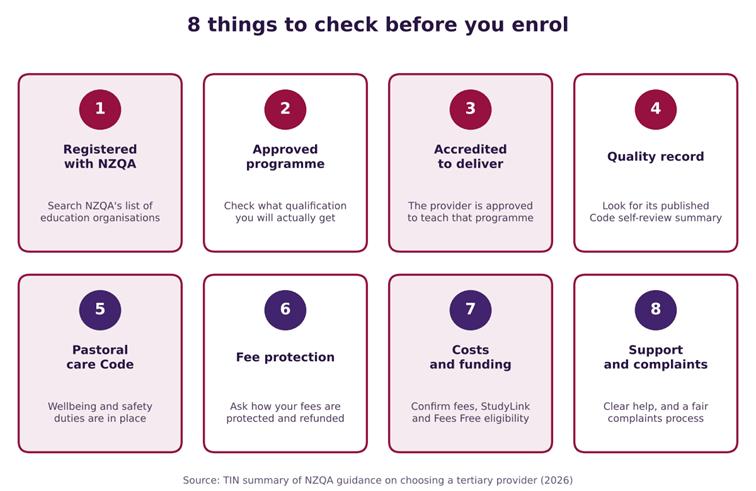
Figure 1: Eight things to check before you enrol. Source: TIN summary of NZQA guidance on choosing a tertiary provider (2026).
Checks 7 and 8: costs, support and complaints
7. What will it cost, and what funding applies? Get the full fee in writing, including resources and any extra costs. If you plan to use a student loan, StudyLink can only fund approved courses. The course must be approved by the Tertiary Education Commission for student loans and allowances, and recognised by NZQA or Universities New Zealand.
Fees Free is also changing. Inland Revenue says Fees Free ends after 31 December 2026. If you finish your qualification after that date, you will not be eligible. Check your situation before you rely on it.
8. What support is there, and how are complaints handled? Ask how the course is delivered, how much study is expected each week and who helps you if you fall behind. If you are studying while working, ask about workplace hours and assessments.
Every tertiary provider must have a complaints process. If a complaint is not resolved, you can contact NZQA about pastoral care issues. After that, Study Complaints | Ngā Amuamu Tauira is a free, independent scheme for domestic and international students. It handles money and contract disputes, such as refunds. It does not handle grades.
Questions to ask before you sign
Before you enrol, NZQA suggests confirming:
- final enrolment dates
- what information you need to provide
- costs and refund rules if you withdraw
- learning resources, learner support and the complaints process.
A registered and accredited provider should be able to answer all of these clearly. If answers are vague, take that as a sign to slow down.
FAQ
How do I check if a provider is NZQA-registered?
Use NZQA’s search for education organisations on its website. You can filter by region and quality assurance status. You can also email NZQA at qaadmin@nzqa.govt.nz.
Do EER categories still matter?
They are being phased out. NZQA stopped starting new EER reviews from 1 January 2026. Some agencies still use existing ratings during the transition. New quality descriptors are expected from July 2027.
Can I get a student loan for any course?
No. StudyLink only funds approved courses that meet TEC and NZQA (or Universities New Zealand) requirements. Check with the provider and StudyLink before you enrol.
What if my provider closes my course?
PTEs must protect learner fees under NZQA’s rules, and fee protection applies if a PTE stops offering your course. Ask your provider how this works for you.
Sources
- NZQA: Choosing a tertiary education provider
- NZQA: New tertiary quality assurance framework goes live (January 2026)
- NZQA: Consultation on describing tertiary education provider quality under iQAF
- NZQA: Tertiary education organisation self-review
- NZQA: Student fee protection information for learners
- Ministry of Education: Tertiary education provider complaints process
- StudyLink: Approved study course or programme
- Inland Revenue: Fees Free will finish at the end of 2026
- TIN: CHC43015 Certificate IV in Ageing Support