
Education consulting: how PTEs can prepare for NZQA’s new quality framework (iQAF)
NZQA’s integrated Quality Assurance Framework (iQAF) is now in place. It changes how private training establishments (PTEs) show their quality. External evaluation and review (EER) is on its way out, and an annual self-review and discussion with NZQA has taken its place. The first self-review summary reports are being submitted now, and they run through to mid-2027. This post explains what has changed, what NZQA asks for and how to prepare well.
Key takeaways
- iQAF went live in January 2026. NZQA has stopped starting new EER reviews, and the EER category system is ending.
- From July 2026, all non-university tertiary providers must complete an annual organisation self-review.
- The self-review summary report is completed online in the MyNZQA provider portal. NZQA does not accept Word or PDF versions.
- Your Code self-review must be published on your website by the time you submit.
- For July 2026 to July 2027, NZQA’s thematic question is the use of generative AI in delivery and assessment.
- NZQA proposes new overall quality descriptors, expected to start from July 2027.
What has changed under iQAF
NZQA announced in January 2026 that iQAF was live, following consultation in 2024 and 2025. A new set of rules, the Quality Assurance of Tertiary Education Providers Rules 2026, replaced the 2022 rules that covered EER. They came into force on 19 January 2026.
Several practical changes affect PTEs:
- No new EER reviews. Reviews already under way were completed, but the EER category rating system is ending. If you still refer to an EER category, NZQA says you must include an accompanying statement as the 2026 rules require.
- Annual self-review. Each year you review your organisation and send NZQA a summary report.
- Financial returns. Under the Private Training Establishment Rules 2026, the annual financial return becomes a return every two years, although NZQA can still ask a particular PTE to file every year.
- Student fee deposits. The threshold for student funds that do not need to go to an independent trustee rose to $1,000 including GST.
Some agencies are keeping existing EER ratings for now. NZQA notes, for example, that Immigration New Zealand will keep using current EER ratings when setting visa conditions in 2026.
The annual self-review: what NZQA asks for
The self-review looks at three things: the quality of education and training (including learner wellbeing and safety), how well your quality assurance systems work, and the outcomes learners achieve. Your Code self-review against the pastoral care Code is now part of this annual process.
The summary report has four parts:
- Context and findings. EFTS and learner numbers, significant changes, and your self-review findings on teaching and learning, assessment, and learner wellbeing and safety.
- Area of interest to NZQA. For July 2026 to July 2027, this is the use of generative AI in delivery and assessment.
- Quality improvement plan. Between three and ten priority actions, each with the problem, the action, a completion date, expected outcomes and how you will measure success.
- Compliance attestation. Confirmation that you meet the Education and Training Act 2020, NZQA rules and the Code, with a link to your published Code self-review summary.
Large text fields allow up to 2,000 characters each. That is not much room, so clear, evidence-based writing matters. Every field must be completed.
When your report is due
NZQA has published a schedule that gives every provider a submission week. The template opens in the portal 10 weeks before your date, and NZQA sends a reminder at least six weeks before. For providers in the Te Hono o te Kahurangi framework, submissions start in April 2027.
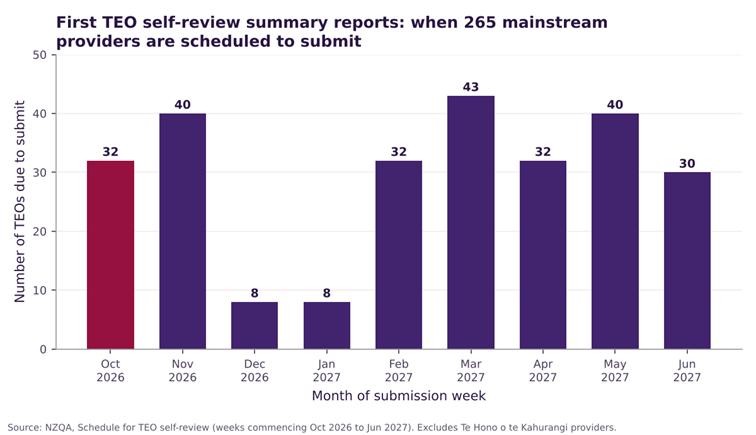
Figure 1: Number of mainstream TEOs scheduled to submit their first self-review summary report, by month. Source: NZQA, Schedule for TEO self-review (Te Hono o te Kahurangi providers not included).
If your date is early in 2027, the summer break will eat into your preparation time. It is worth starting now.
After you submit: the annual discussion
Once you submit, the report cannot be edited. An NZQA evaluator reviews it and may contact you within five working days if more information is needed. NZQA then holds an online discussion of about 90 minutes with your leaders. It covers significant changes, improvements and challenges, the thematic question and whether your improvement plan fits what NZQA’s data shows. NZQA follows up on the improvement plan about six months later.
NZQA describes the self-review discussion as not a monitoring process, and there is no charge for taking part. Summary reports and discussion summaries are not published.
What comes next: quality descriptors
Providers and agencies told NZQA that a simple pass or fail rating was too limited. In mid-2026 NZQA consulted on a graded approach. It proposed four quality criteria: programme and micro-credential design, delivery of education and training, assessment practice, and how well the quality management system is put into practice. Scores would map to three overall descriptors: Highly effective, Effective or Not effective.
Consultation closed on 7 September 2026, and no final decisions have been announced. NZQA expects to consult on any supporting rules in February or March 2027 and to start using the descriptors from July 2027. The evidence you build through self-review now is likely to matter for that.
How education consulting can help
A good self-review is honest, focused and backed by evidence. An outside view can help you get there. TIN’s Education Consulting team can work alongside your staff to:
- review your quality management system and evidence against the new rules
- plan and run a self-review process that involves staff and learners
- shape three to ten realistic improvement actions with clear measures
- check your Code self-review summary is complete and published
- think through how you use generative AI in teaching and assessment
- prepare your leaders for the NZQA discussion.
FAQ
Does iQAF replace EER?
Yes. NZQA stopped starting new EER reviews from 1 January 2026, and the EER category system is ending. Annual self-review and discussion with NZQA is now the main process.
Can we submit the summary report as a Word document?
No. NZQA only accepts the report through the MyNZQA provider portal. The PDF template is for reference only.
When do we find out our submission date?
Your week is on NZQA’s published schedule. NZQA sends a reminder at least six weeks before, and the portal template opens 10 weeks before.
Will NZQA give us a quality rating?
Not yet. NZQA has proposed descriptors of Highly effective, Effective and Not effective, with use expected from July 2027. These are still being finalised.
Get ready with TIN
If your submission week is coming up, or you want a fresh pair of eyes on your quality systems, talk to TIN’s Education Consulting team. Call 021 081 75976, email admin@tin.ac.nz or visit our contact page.
Sources
- NZQA: New tertiary quality assurance framework goes live (January 2026)
- NZQA: Changes to NZQA Rules
- NZQA: Tertiary education organisation (TEO) self-review
- NZQA: TEO self-review summary report
- NZQA: Schedule for TEO self-review
- NZQA: Information sessions on TEO self-review
- NZQA: Consultation on describing tertiary education provider quality under iQAF