
Health and safety training for small NZ businesses: what the law expects
Running a small business means wearing a lot of hats. Health and safety is one of them, whether you have two staff or twenty. The good news is that the law does not expect a mountain of paperwork. It expects training that fits your work and actually keeps people safe. This guide explains what New Zealand law asks of small businesses, what is changing in 2027, and how to build a simple training approach that works.
Key takeaways
- Under the Health and Safety at Work Act 2015 (HSWA), every business must, so far as is reasonably practicable, give workers the information, training, instruction or supervision they need to work safely.
- Training must be suitable for the work and easy for your workers to understand. A tick-box exercise is not enough.
- You also need trained first aiders (your own or accessible nearby) and a written emergency plan that workers are trained in.
- Training records are not legally required, but they are the easiest way to show what you have done.
- The Health and Safety at Work Amendment Act 2026 comes into force on 1 April 2027. It sharpens the focus on critical risks and clarifies duties for small businesses.
What the law says about training
HSWA sets a primary duty of care for every person conducting a business or undertaking (PCBU). Part of that duty, in section 36, is to provide the information, training, instruction or supervision needed to protect workers and others from risks arising from the work.
The detail sits in the Health and Safety at Work (General Risk and Workplace Management) Regulations 2016, often called the GRWM Regulations. Regulation 9 says the information, training, instruction and supervision you provide must be suitable and adequate. According to WorkSafe’s guidance, that means:
- Workers who do risky work, use plant or handle hazardous substances must either know how to do it safely or be supervised by someone who does.
- Workers must be trained in the safe use of the equipment, substances and personal protective equipment (PPE) they use.
- Information and training must be easy to understand for the people receiving it.
- You must involve your workers when deciding how training is delivered.
- Trainers and supervisors, whether in-house or external, should be competent.
What good training looks like in a small business
WorkSafe’s guidance says training should be tailored and fit for purpose. When you plan it, think about:
- The work and the workplace. What tasks are done, and where?
- The risks. What could seriously hurt someone, and what controls are already in place?
- Your people. Their experience, first language, literacy and how they learn best.
- Emergencies. What everyone needs to know if something goes wrong.
- Timing. New workers may need close supervision until they show they are competent.
- Delivery. Demonstrations, pictures, spoken instructions or a buddy system often work better than a long document.
- Checking understanding. Watch people work, ask questions or use short quizzes.
- Refreshers and reviews. Revisit training after changes, incidents or feedback, and on a regular schedule.
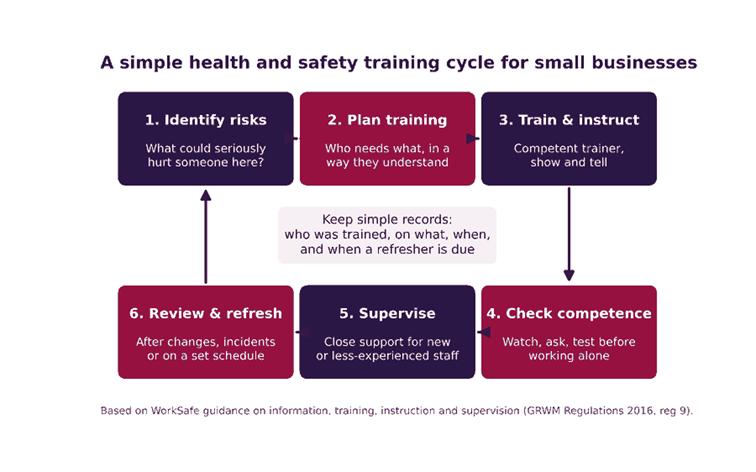
Figure 1: A simple health and safety training cycle for small businesses. Based on WorkSafe guidance on information, training, instruction and supervision (GRWM Regulations 2016, regulation 9).
First aid and emergency plans
Two other training-related duties apply to almost every workplace:
- First aid (regulation 13). You must have trained first aiders at the workplace, or make sure workers can reach trained first aiders elsewhere, such as at a neighbouring business. How many you need depends on your workforce, the type of work and hazards, and how quickly emergency services can arrive.
- Emergency plans (regulation 14). You must have a written emergency plan. It covers evacuation, contacting emergency services, getting medical help and communicating during an emergency. It also says how often procedures will be tested and what training workers need to carry them out.
What is changing in 2027
The Health and Safety at Work Amendment Act 2026 received Royal Assent on 9 July 2026. MBIE says it will come into force on 1 April 2027. Key changes include:
- A sharper focus on managing critical risks, with critical risk now defined in the law.
- A definition of a small PCBU, with clearer duties for small businesses on critical risks.
- A clearer due diligence duty for officers, such as directors.
- Approved Codes of Practice as a safe harbour. If you follow an approved code for a specific risk, you are treated as having met your duty for that risk.
MBIE and WorkSafe are preparing guidance on how these changes work in practice. In the meantime, the current duties still apply. Good training on your most serious risks is the best preparation for the new focus on critical risks.
Keeping records
WorkSafe says you are not required to keep training records. Even so, simple records make life easier. A basic training register can show who was trained, on what, when, by whom, and when a refresher is due. It helps you spot gaps and shows you have taken your duties seriously if anything goes wrong.
Frequently asked questions
Do small businesses have to provide health and safety training?
Yes. Every PCBU must, so far as is reasonably practicable, provide the information, training, instruction or supervision workers need to work safely. What that involves depends on your work and its risks.
Does training have to be done by an external provider?
No. Training can be done in-house, as long as the person delivering it is competent. Many small businesses use a mix of on-the-job training and external courses for specialist topics like first aid.
Do I have to keep training records?
Not by law, according to WorkSafe. But records are strongly recommended, because they help you manage refreshers and show what you have done.
When do the 2026 law changes start?
MBIE says the Health and Safety at Work Amendment Act 2026 comes into force on 1 April 2027.
How TIN can help
TIN offers Health & Safety and Training services to help businesses understand their duties and put practical training in place. If you would like to talk about what your business needs, call 021 081 75976, email admin@tin.ac.nz, or get in touch through our contact page.
This article is general information, not legal advice.